Rethinking L&D as a Human-Centered Strategy in a Rapidly Changing Workplace with Alissa Weiher of UCHealth
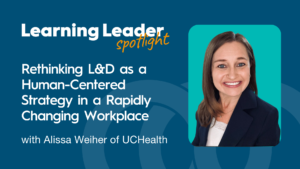
This episode of Learning Leader Spotlight, hosted by Tracy D. Lufkin of TrainingPros, features an in‑depth conversation with Alissa Weiher, Senior Director of Organizational Development, Engagement, and Retention at UCHealth. Throughout the discussion, Weiher offers a grounded and energizing look at how learning leaders can shape talent strategy, partner across HR functions, and evolve their work through human‑centered design, data, and emerging technologies such as AI. Her reflections illuminate both the changing landscape of L&D and the mindset shifts required to thrive in it.
Alissa Weiher oversees everything from hire‑to‑retire programs to onboarding, recognition, coaching, and leadership development. She brings 20 years of experience that began in hands‑on teller training and grew into progressively strategic leadership roles across multiple industries. Her work centers on connecting talent strategy, capability building, and employee experience in service of organizational performance and long‑term workforce sustainability.
Key Themes and Shifts Discussed
1. L&D as a Strategic Partner in Talent Strategy
Weiher emphasizes that one of the biggest shifts in her career is not a change in the L&D field itself, but a change in how she operates within it. Rather than viewing learning as a standalone function that “fixes skill gaps,” she now sees it as part of a broader talent system that includes talent acquisition, total rewards, and workforce planning.
She explains that sustainability depends on integrating these functions to answer questions such as:
- Is a needed skill available in the external market?
- Should the organization build the capability internally instead?
- How long will development take, and what talent gaps need bridging?
- How is compensation or tuition reimbursement already positioned to support development?
This shift reframes L&D from content creation into strategic workforce design, where learning plays one part in developing, acquiring, and retaining talent.
2. The Expanding Role of AI
AI is an unavoidable force reshaping work, and Weiher speaks candidly about both its potential and its limits. She notes two major concerns for organizations:
- AI’s real impact on jobs. Large‑scale layoffs across industries reflect genuine role redesign, requiring proactive reskilling, upskilling, and redeployment.
- The need for human oversight. She shares examples where AI‑generated content was “garbage,” reinforcing the need for validation, testing, and thoughtful design.
Despite the pitfalls, AI offers powerful opportunities:
- Scalability for small L&D teams by generating drafts, documentation, or templated materials
- Acceleration of brainstorming and idea generation
- Support for cross‑functional insight gathering through data synthesis
Weiher underscores that AI is most valuable when paired with human judgment, empathy, and testing, particularly because AI outputs often interface directly with employees or learners.
3. Data as the Connective Tissue Across HR Functions
A theme woven throughout the episode is the importance of integrating data from multiple parts of the employee lifecycle. Weiher highlights that her team manages:
- Onboarding and exit surveys
- Employee engagement metrics
- Recognition platform usage
When combined with data from:
- Talent acquisition
- Benefits and total rewards
- Patient experience and quality metrics (in the healthcare environment)
…leaders can identify trends, gaps, and opportunities that would not surface in isolated data sets.
Weiher acknowledges that she loves data but prefers partnering with specialists who can extract insights. The central message: data matters, but questioning the data matters just as much.
4. Learning Agility as a Core Leadership Capability
Asked to name the most important skill for learning leaders, Weiher prioritizes learning agility to:
- Reflect on past experiences
- Extract what worked and what didn’t
- Transfer insights into new or ambiguous contexts
- Understand the emotional and human dynamics that influence change
She describes learning agility as essential for navigating complex environments, especially when supporting leaders, guiding change, or making strategic decisions under uncertainty. It is also deeply tied to empathy and self‑reflection, both of which she practices openly with her team.
5. Innovation as Iteration, Not Reinvention
Weiher describes innovation as “little nuanced adaptations,” contrasting with the common perception of disruptive breakthroughs. She reinforces that innovation often means:
- Building on others’ ideas
- Making small enhancements
- Reconsidering familiar tools or processes
- Evolving materials, programs, or experiences incrementally
Her example of the evolution from iPod to iPhone illustrates how iterative progress can redefine user expectations and experiences. Applied to L&D, innovation emerges from staying curious about learner needs, exploring new technologies, and experimenting with tweaks rather than waiting for dramatic leaps.

Learning Trends Shaping theFuture: What Leaders See Coming Next
Practical Takeaways for L&D and Business Leaders
1. Embed L&D Into the Broader Talent Ecosystem
Leaders can improve workforce sustainability by integrating learning with:
- Talent acquisition data and hiring strategies
- Total rewards offerings like tuition reimbursement
- Workforce planning projections and succession needs
This approach shifts L&D from a reactive service provider to a strategic co‑architect of workforce capability.
2. Approach AI as a Collaborator, Not a Replacement
AI can help scale small teams, accelerate content creation, and surface patterns across data, but only when paired with human validation. Leaders benefit from:
- Using AI for first drafts, not final outputs
- Testing AI‑generated materials with humans before rollout
- Emphasizing the human experience to avoid unintended consequences
- Coaching teams to adopt AI as a habit rather than an occasional experiment
3. Use Integrated Data to Uncover Workforce Insights
Gathering and combining data across the employee experience can illuminate trends not visible within individual data sources. Leaders can:
- Connect engagement data with turnover trends
- Link recognition usage with performance or retention
- Pair survey data with recruitment metrics to inform strategy
- Examine how benefits utilization influences development or mobility
Cross‑functional data enables better decision‑making and more targeted support.
4. Invest in Learning Agility at All Levels
Learning agility enables leaders and teams to adapt quickly and thoughtfully. Practical actions include:
- Regular reflection practices
- Encouraging teams to share lessons learned
- Treating emotional and human dynamics as strategic considerations
- Modeling openness about mistakes and course corrections
Weiher’s example of owning a leadership misstep and discussing it with her team shows how learning agility builds trust and continuous growth.
5. Promote Everyday Innovation Through Small Improvements
Instead of pursuing only large‑scale innovation projects, leaders can create a culture of incremental improvement by:
- Celebrating enhancements rather than only breakthroughs
- Inviting teams to add “one small improvement” to existing work
- Evaluating how technology can simplify or optimize workflows
- Encouraging experimentation even when outcomes are uncertain
Innovation becomes accessible to all employees when reframed as iteration.
Finding Your Next L&D Leadership Role
Optional Resources or Tools Mentioned
- Association for Talent Development (ATD) — cited by Weiher as a frequent source of professional insight and community.
- Learning Geeks Podcast — mentioned as a favorite resource for industry perspectives.
- “Leading the Learning Function” — a book featuring chapters from multiple learning leaders; Weiher contributed a chapter on developing L&D teams.
Closing Reflection
Alissa Weiher’s conversation highlights the evolution of learning leadership toward a more integrated, human‑centered, and data‑informed practice. Her reflections illustrate how L&D can shape future‑ready organizations by embracing AI responsibly, championing collaboration across HR functions, and cultivating learning agility and innovation. The episode underscores that while tools and technologies continue to evolve, human connection, curiosity, and adaptability remain at the heart of effective learning leadership.
Ready to Work with Us?
Does your L&D team have more projects than people? TrainingPros has been named a Top 20 Staffing Company internationally by Training Industry, and recognized as a Smartchoice® Preferred Provider by Brandon Hall Group for 2025. We’re also proud to be named a Champion of Learning by the Association for Talent Development (ATD)—an international honor that reflects our dedication to excellence in corporate learning. These accolades underscore TrainingPros’ unwavering commitment to delivering high-quality, tailored training solutions.
If your projects need instructional design consultants, eLearning developers, or other learning & development consultants for your custom content projects, reach out to one of our industry-expert relationship managers today.
When you have more projects than people™, let TrainingPros find the right consultant to start your project with confidence. Schedule a consultation today.