Building Future-Ready Cultures Through Strategic L&D with Rapti Khurana of PortlyAI
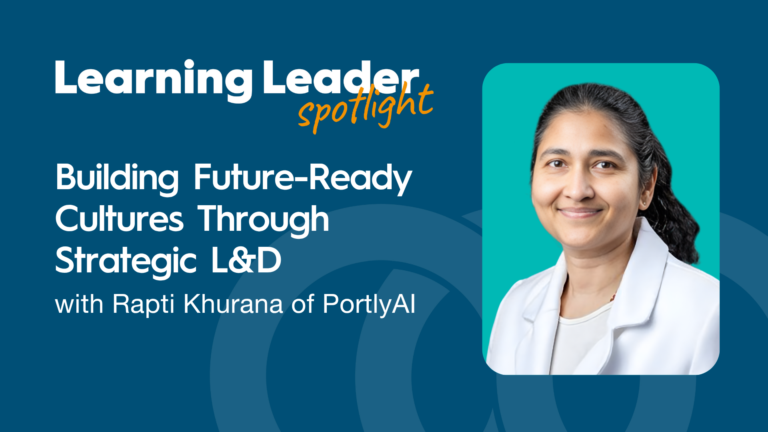
In this episode of Learning Leader Spotlight, Rapti Khurana of PortlyAI explores how learning and development is shifting from content delivery to strategic capability building. Drawing on her experience leading enterprise learning and talent strategies, she outlines how L&D leaders can create learning ecosystems that balance speed, personalization, and human connection. The conversation emphasizes the growing responsibility of learning leaders to directly enable business performance and future readiness.
Rapti Khurana is a learning and talent development leader whose work centers on building high-performing, future-ready organizational cultures. Most recently, she served as Vice President of Talent Engagement and Development at the National Football League, where she focused on leadership development, learning strategy, and capability building. Rapti describes her role as operating at the intersection of people, performance, and possibility, positioning learning as a strategic lever rather than a support function.
From Content-Centric to Capability-Centric Learning
A central theme of the discussion is the shift away from content-driven training toward capability-centered learning strategies. Rapti explains that L&D leaders are no longer asking what training programs to offer but instead asking what capabilities the business needs next and how quickly those capabilities can be built. This reframing aligns learning priorities directly with organizational strategy and future business demands.
Rather than measuring success by the volume of content produced, learning leaders are increasingly expected to demonstrate how learning initiatives enable performance, adaptability, and strategic execution.
L&D’s Expanding Role in Business and HR Strategy
Rapti highlights that learning leaders are now more frequently positioned at the strategic table alongside HR and business leadership. Chief Learning Officers are playing a growing role in shaping enterprise talent strategies, particularly as organizations respond to technological disruption and artificial intelligence. Learning is no longer viewed as a standalone function but as a core driver of workforce enablement and organizational resilience.
This shift also raises expectations for L&D leaders to align learning outcomes with business KPIs and demonstrate a measurable impact beyond traditional learning metrics.
Designing for Paradox: Speed and Human Connection
The conversation emphasizes the paradox facing modern learning organizations. On one hand, employees want asynchronous learning embedded in the flow of work. On the other hand, they are craving connection, community, coaching, and shared experiences. Rapti argues that effective learning strategies must intentionally be designed for both.
She describes learning ecosystems where foundational knowledge is delivered through technology, while deeper learning is reinforced through cohort experiences, peer learning, and community-based engagement.
Learning as an Experience, Not an Event
Rapti stresses that learning must be designed as an intentional system rather than a collection of isolated programs. Videos, platforms, or on-the-job training alone are insufficient to drive lasting behavior change. Instead, learning experiences should allow individuals to experiment, apply new skills, and reflect with others in real work contexts.
This experiential approach increases the likelihood that learning will stick and translate into performance improvement.
The Future of L&D: Combining Scale with Intimacy
Looking ahead, Rapti predicts that learning will become increasingly hyper-personalized, experiential, and human-centered. Personalized learning journeys, modular content, and learning embedded in daily work will continue to grow. At the same time, high-impact human experiences such as coaching, cohort programs, simulations, and action learning will remain essential.
She summarizes the future of L&D as the ability to combine scale with intimacy by using technology and AI to personalize learning while preserving space for reflection, conversation, and human connection.

Learning Trends Shaping the Future
Practical Takeaways for L&D and Business Leaders
1. Anchor Learning Strategy in Business Capabilities
L&D leaders should begin with a clear understanding of the capabilities the organization will need in the near future. Learning investments should be prioritized based on strategic value rather than demand for content or historical program offerings.
2. Design Learning Ecosystems, Not Isolated Programs
Effective learning requires an integrated system that blends technology-enabled learning with human-centered experiences. Leaders should intentionally design how tools, content, coaching, and community interact to support sustained learning and application.
3. Measure What Matters to the Business
Rapti underscores the importance of connecting learning outcomes to business KPIs. L&D leaders must move beyond traditional completion of metrics and demonstrate how learning contributes to performance, adaptability, and organizational results.
4. Leverage Social and Experiential Learning
Peer learning, cohort-based experiences, and opportunities for reflection and experimentation play a critical role in making learning stick. Organizations that create space for dialogue and shared learning are more likely to foster resilience, innovation, and curiosity.
5. Embrace Reverse Mentoring and Cross-Functional Insight
Rapti highlights the value of learning from junior team members and peers outside the L&D function. Reverse mentoring provides insight into emerging trends, generational preferences, and new ways of working, helping learning strategies remain relevant and engaging.
Optional Resources or Tools Mentioned
- Immunity to Change by Robert Kegan and Lisa Lahey, recommended for its exploration of why sustainable change requires shifts in mindset, identity, and behavior, not just skill development.
- Industry sources referenced include Chief Learning Officer Magazine, Workforce Magazine, Gartner, McKinsey Quarterly, and practitioner-led learning forums.
Closing Reflection
This episode reinforces the idea that the future of learning and development lies in strategic capability building, not content production. Rapti Khurana’s perspective highlights the growing responsibility of learning leaders to balance the technological scale with meaningful human connection. By designing intentional learning ecosystems aligned to business priorities, L&D can play a defining role in shaping adaptable, future-ready organizations.
Ready to Work with Us?
Does your L&D team have more projects than people? At TrainingPros, we match organizations with experienced consultants who lead with strategy, so you can connect learning decisions to real business goals. We support teams across compliance, customer service, leadership and supervisory development, product knowledge, and sales, as well as information technology, software, and learning platforms. Whether you’re rethinking onboarding, scaling a program, or upgrading the tools behind it, we help you move from reactive delivery to results-driven capability building.
TrainingPros has been named a Top 20 Staffing Company internationally by Training Industry, and recognized as a Smartchoice® Preferred Provider by Brandon Hall Group for 2025. We’re also proud to be named a Champion of Learning by the Association for Talent Development (ATD)—an international honor that reflects our dedication to excellence in corporate learning. These accolades underscore TrainingPros’ unwavering commitment to delivering high-quality, tailored training solutions.
If your projects need instructional design consultants, eLearning developers, or other learning & development consultants for your custom content projects, reach out to one of our industry-expert relationship managers today.
When you have more projects than people™, let TrainingPros find the right consultant to start your project with confidence. Schedule a consultation today.