Driving Business Impact Through L&D Metrics with Karen Massey of AWP Safety
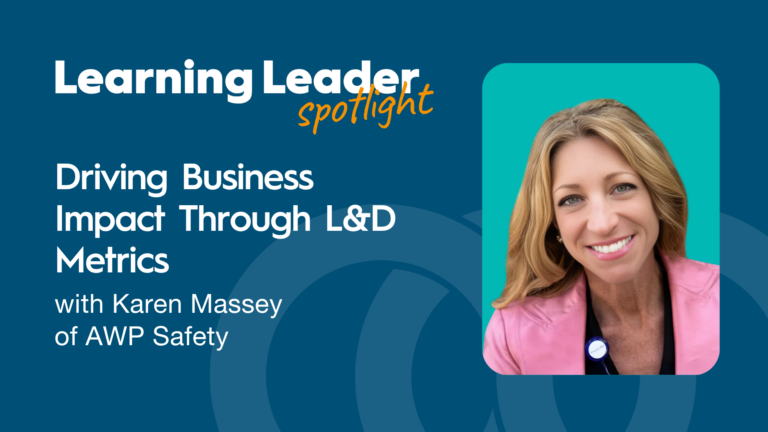
This episode of Learning Leader Spotlight features a conversation with Karen Massey, Senior Director of Training and Qualification at AWP Safety. She’s a learning and organizational development (L&OD) leader with more than 20 years of experience across healthcare, manufacturing, nonprofits, and the Department of Defense. Interviewed by TracyDee Lufkin of TrainingPros, Karen shares why improving performance through learning requires a holistic, organizational approach; one that’s aligned to business outcomes, built on strong processes, and measured in ways leaders care about.
Karen explains her current focus on training and qualification: ensuring people are prepared and certified to do the work safely and effectively, developing train-the-trainer capability, upskilling supervisors, and using scorecards and other measures to confirm readiness. She also offers a grounded view of what has changed most in L&D recently; an intensified focus on AI, value, and moving from “order taker” to true business partner.
Throughout the episode, Karen reframes the function as L&OD (learning and organizational development) because sustainable performance change rarely comes from a single class or a “parachute-in” training fix. Instead, she advocates for an enterprise lens; partnering with the business to clarify desired outcomes, diagnosing what’s really driving performance, and aligning learning with structures, processes, and leadership behaviors that support execution.
Why L&D Has to Think Like L&OD: Performance Requires an Organizational Approach
Karen’s central message is that learning only changes performance when it is designed as part of the wider system. That means aligning learning initiatives to the business strategy, the organizational structure, and the realities of how work gets done, not treating training as a one-time event or a stand-alone class.
She notes that the old model, where the business asks for a course and L&D simply delivers it, is fading fast. Today’s expectation is partnership. L&OD teams run intake conversations, ask deeper questions, and help leaders define the outcome they want to see. Sometimes that means recommending something other than the requested class, which can create healthy tension, but ultimately results in solutions that actually move the needle.
Value, Metrics, and Business Outcomes:
The New Center of Gravity
When Karen describes the most impactful changes she’s seen in recent years, she points to a stronger emphasis on proving value. For L&OD, that often shows up as metrics: connecting learning efforts to performance outcomes the business can see, including quality, safety, productivity, readiness, and leader effectiveness, rather than treating attendance or completion as the goal.
In her current training and qualification work, that value orientation includes building structured certification pathways, running train-the-trainer programs, and using tools like supervisor scorecards to ensure people can consistently perform on the job. The point is not simply to deliver learning, but to measure readiness and support leaders in reinforcing the behaviors and standards that drive results.
Karen also cautions against the pattern many organizations fall into: repeatedly requesting the same familiar offerings (leadership development, crucial conversations, coaching) because that’s what people think L&OD does. A disciplined intake process helps reset expectations by clarifying the outcome first, then selecting the right mix of interventions to reach it.
AI as a Performance Accelerator:
Upskilling People to Use the Tools Well
Karen sees AI as one of the biggest drivers of change in the field, both because it can make L&OD teams more efficient and because it can dramatically increase the output of employees across the organization. The opportunity is not just to deploy tools, but to ensure people know how to use them effectively to get better, faster at their work.
She shares a practical example: when tools like Microsoft Copilot are embedded in internal systems, employees can often answer questions themselves by creating reports, pulling information, or generating dashboards, rather than waiting in line for IT or for one-off trainings. But this only works when L&OD helps people move beyond basic use. As Karen puts it, most of us use a small fraction of what our tools can do. Targeted enablement unlocks the rest.
Guardrails, Governance, and Responsible Use
As organizations embed AI into their workflows, Karen emphasizes the importance of governance: clear rules for what tools are approved, what data can be used, and how employees should apply AI responsibly. Without guardrails, well-intended experimentation can introduce real risk, especially when proprietary information is involved.
She highlights a key distinction: using AI tools that are embedded internally (with appropriate security) versus uploading sensitive information into public tools where it could be exposed. This is why IT leaders often “love and hate” AI at the same time. Its promise is real, but so are the cybersecurity and data governance concerns. L&OD can support adoption by helping employees understand not only how to use AI, but what not to do.
L&OD at the Table: From the Fringe to a
True Business Partner
Karen describes a broader shift in expectations: L&OD can’t sit on the fringe of the organization anymore. As AI and other accelerators reshape how work gets done, learning leaders have an opportunity and a responsibility to serve as strategic partners who connect capability building to real business performance.
That partnership shows up in practical ways: running strong intake conversations, challenging assumptions about “the training we need,” and aligning interventions with leadership expectations, processes, and measures of success. In Karen’s view, the differentiator is not how many courses a team can deliver, but how well it can diagnose needs, design aligned solutions, and demonstrate impact.

Learning Trends Shaping the Future – What Learning Leaders See Coming Next
Influences and Mentorship: Learning From Systems, Cultures, and Strong Leaders
When asked about her most influential professional mentors, Karen points to an uncommon source: the systems and cultures she has worked in over time. Early in her career, the Department of Defense environment gave her a strong foundation in standard operating procedures, structure, and the value of process and governance. Those lessons helped her navigate both slower, highly regulated organizations and faster-moving businesses later on.
She also describes gravitating toward leaders who model integrity and accountability: people who build strong teams, make hard decisions, and don’t allow poor behavior to persist. Those examples reinforced that leadership is not only a title; it’s reflected in the choices you own and the standards you set, especially when outcomes don’t go as planned.
A Practical Lens: Training, Qualification, and Leader Support
In her current role, Karen’s work sits close to the frontline: ensuring people are trained, qualified, and supported to do the job well. That includes building repeatable learning pathways for skill development and certification, so expectations are clear and performance can be verified, not assumed.
She also emphasizes the role of leaders in sustaining capability. Tools like supervisor scorecards and structured coaching expectations help managers provide consistent support, reinforcing that training is only one part of a larger performance system. When leaders are equipped to observe, coach, and hold standards, qualification programs become more than events. They become operational habits.
Practical Takeaways for Learning and
Organizational Development Leaders
- Lead with outcomes, not requests. Use a disciplined intake process to clarify what performance change the business wants; then recommend the right solution (which may or may not be a class).
- Adopt an enterprise lens. Sustainable behavior change requires alignment to structure, process, leadership expectations, and how work actually flows across the organization.
- Measure what matters. Move beyond completion metrics to readiness, quality, safety, productivity, and leader effectiveness, tying learning to organizational objectives or outcomes.
- Treat AI as an accelerator and teach responsible use. Upskill teams on tools like Copilot so they can work faster and smarter, while reinforcing governance and data boundaries.
- Equip leaders to sustain performance. Qualification programs work best when supervisors have clear coaching expectations and tools (like scorecards) to reinforce standards on the job.
Topics and Tools Mentioned
Closing Reflection
Karen Massey’s perspective is a useful reminder that learning functions create the most value when they think beyond courses. By approaching capability building as L&OD, embedded in the organization and aligned to business priorities, learning leaders can move from reactive delivery to measurable performance impact.
Her comments on AI also land with practical balance: AI is here, it can accelerate outputs, and it can reduce bottlenecks, but only if people are trained to use the tools well and the organization sets clear guardrails for responsible use. Governance, in this sense, becomes part of enablement.
Ultimately, the episode reinforces a leadership theme that runs through Karen’s career: strong systems, clear standards, and accountable leaders create the conditions where learning can stick. For L&OD teams navigating rapid change, the path forward is to stay close to the business, ask better diagnostic questions, and connect learning investments to outcomes that matter.
Ready to Work with Us?
Does your L&D team have more projects than people? At TrainingPros, we match organizations with experienced consultants who lead with strategy, so you can connect learning decisions to real business goals. We support teams across compliance, customer service, leadership and supervisory development, product knowledge, and sales, as well as information technology, software, and learning platforms. Whether you’re rethinking onboarding, scaling a program, or upgrading the tools behind it, we help you move from reactive delivery to results-driven capability building.
TrainingPros has been named a Top 20 Staffing Company internationally by Training Industry, and recognized as a Smartchoice® Preferred Provider by Brandon Hall Group for 2025. We’re also proud to be named a Champion of Learning by the Association for Talent Development (ATD)—an international honor that reflects our dedication to excellence in corporate learning. These accolades underscore TrainingPros’ unwavering commitment to delivering high-quality, tailored training solutions.
If your projects need instructional design consultants, eLearning developers, or other learning & development consultants for your custom content projects, reach out to one of our industry-expert relationship managers today.
When you have more projects than people™, let TrainingPros find the right consultant to start your project with confidence. Schedule a consultation today.