Preparing L&D Teams for Agentic AI with Adrienne Smith of Samsara
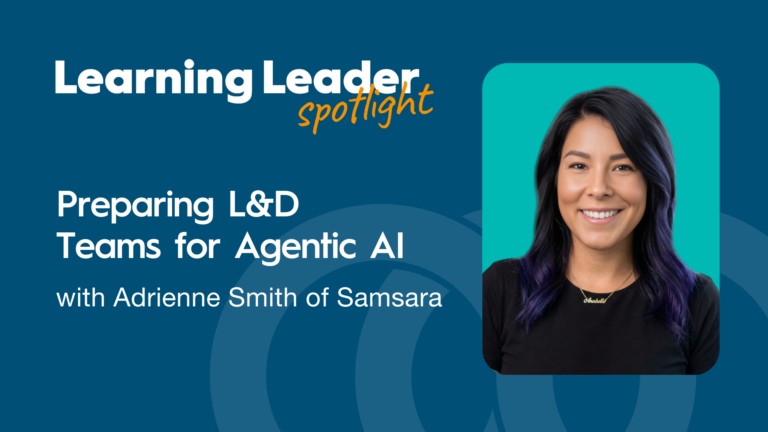
This episode of Learning Leaders Spotlight features a conversation with Adrienne Smith, Manager of Global Learning and AI Development at Samsara. Adrienne shares how learning and development teams can prepare for the shift from using generative AI as a prompt-based assistant to adopting agentic AI, systems designed to pursue goals, execute multi-step workflows, and take action across tools. The discussion emphasizes what L&D leaders can do now: identify high-friction tasks that agents can automate, understand the enabling technology (like natural-language connectors), and establish strong ethics and governance before scaling agent use.
Adrienne explains that Samsara brings AI to the world of physical operations, helping organizations improve safety, efficiency, and sustainability through a connected operations platform powered by its own hardware and massive data sets. In her role, she leads a global learning team responsible for onboarding new hires on day one, introducing employees to Samsara’s AI-forward ways of working, and owning leadership development across the organization.
Throughout the episode, Adrienne frames agentic AI as a major inflection point for the profession. As business units begin deploying agents to solve immediate problems and close skill gaps, L&D’s value shifts from being the sole curator of content to becoming an architect, setting standards for learning intent, measurement, and responsible use. Her message is optimistic but clear: adoption should be paired with discipline, because the teams that win won’t be the ones with the most agents, but the ones with the strongest governance.
From Prompts to Goals: Generative AI vs. Agentic AI
Adrienne describes how most teams have used AI over the past few years: like a high-speed search engine or a “fancy typewriter.” In that generative AI mode, the interaction is largely reactive; someone writes a prompt, the tool returns text, and the human decides what to do next.
Agentic AI, by contrast, is organized around a goal, not a single prompt. Adrienne explains that an agent can break a complex request into steps, work through those steps, and take actions across multiple systems. For example, an agent could pull a list of new-hire names from a source document, merge them into a communication template, and draft the email automatically, acting less like a chatbot and more like a digital teammate that can reduce manual work.
Why Building Agents Is More Accessible Than It Used to Be
Adrienne notes that “building agents” can sound intimidating. Not long ago, making AI do anything beyond answering questions usually meant involving technical teams, writing code, and stitching different systems together. Today, many AI tools have simplified that setup, so non-technical teams can start experimenting without needing to be programmers.
In plain terms, newer tools make it easier for AI to “reach into” the places you already work, like shared folders, email, or simple utilities. Instead of building complicated custom links, you can often turn on connections and then describe what you want in everyday language. Adrienne also cautions that many “prebuilt agents” are being sold right now, so it’s worth asking questions and testing before you adopt one. A helpful approach is to use AI as your tutor: ask it to explain agentic AI in simple language, then ask follow-up questions until it makes sense.
To stay current without feeling overwhelmed, Adrienne recommends starting with Ethan Mollick’s book, Co-Intelligence: Living and Working with AI, and subscribing to his newsletter. She describes it as a steady, approachable way to keep up with what’s changing, so you can build confidence over time instead of trying to learn everything at once.
Where to Start: High-Friction, Low-Variability Work
Adrienne’s first recommendation is simple: start with the tasks your team gripes about, work that is time-consuming, repetitive, and easy to define. She calls these high-friction, low-variability tasks: the rules don’t change much, the desired output is clear, and that consistency makes them good candidates for early agents.
She also encourages teams to shift their mindset from “prompting” to “goal setting.” Instead of asking for a single output (for example, a course outline), try a multi-step outcome (for example: research competitor updates, compare them to what your sales materials claim, and draft a short enablement update for the team). Practicing this kind of request helps L&D professionals think in workflows, which is exactly the muscle agentic systems are designed to support.
A key engagement lever Kimberly highlights is digital badging. When learners earn a certification, they want visible proof, badges that can be displayed on LinkedIn, added to email signatures, or used as part of a digital resume. Kimberly describes the motivational impact in terms of FOMO (fear of missing out): when someone sees a coworker post a credential, it often prompts others to pursue the same certification. She notes that this creates a “snowball effect,” increasing participation and strengthening adoption of Nielsen products and data services. From a business standpoint, that improved adoption makes the offering “stickier,” supports renewals, and can even contribute to new business by demonstrating user competence and commitment.

Learning Trends Shaping the Future – What Learning Leaders See Coming Next
Tech Stack Access and the Shift to “In the Flow of Work” Support
Adrienne emphasizes that successful agents need access to the systems where work actually happens, the tech stack. She explains that the power of agentic AI is not only producing content, but integrating with tools (for example, CRMs, call recording platforms, and messaging apps) so that guidance can show up at the moment of need.
She uses a sales enablement scenario to illustrate the point: an agent could analyze a recorded call, identify where a rep struggled with an objection, and suggest a quick two-minute role play right in the workflow. As departments begin launching their own agents to address skill gaps, Adrienne argues L&D must evolve from “content curator” to learning architect or agent architect, ensuring agents reflect sound learning objectives, measurement strategies, and organizational priorities.
Ethics and Governance: The New L&D Differentiator
Adrienne is clear that governance has to come before scale. In her view, “the best L&D person” won’t be the one with the most agents, but, instead, the professional with the tightest ethics and governance. Agents may touch proprietary information and people data, and they may provide guidance that shapes real decisions, so boundaries have to be explicit and tested.
She highlights risks such as agents stepping beyond intended permissions, or multiple agents offering conflicting recommendations for similar tasks. Adrienne encourages L&D leaders to become “architects of intent,” optimistic about adoption, but willing to ask hard implementation questions, verify protections, and ensure agents are not deployed with broad access until safeguards are in place.
How Adrienne Upskills Her Team for Rapid AI Change
To keep her team current, Adrienne starts with the basics: subscribe to reliable updates (like Mollick’s newsletter), read and discuss them together, and create space for experimentation. She explicitly gives her team permission to “waste time” in tools, because, as she puts it, sometimes you have to slow down to speed up. That learning curve is expected with any AI adoption.
Adrienne also built a six-week internal program (developed with the help of generative AI) that culminates in each team member building an agent. Early weeks focus on understanding company policies for ethics and governance, then progress into hands-on building and troubleshooting. She normalizes frustration; getting close and then failing is part of the process, and she encourages using AI to diagnose stuck points: describe where you are, what you tried, and ask what to do next.
A Practical Example: Automating Onboarding Communications
Adrienne shares an early agent use case from her team: onboarding emails and communications. It was a task taking roughly two hours each week, time she wanted her team to reinvest in more strategic work. Her approach underscores an important adoption pattern: prove value on a contained, repeatable workflow before expanding scope.
To build safely, she created fake data, replicating the documents and templates involved, but populating them with non-real names, roles, and emails. Using natural language, she guided the agent with clear parameters: what runs when, who should be included, and what the template should look like. The agent then merged the information and produced a draft email in her inbox for review before sending. She notes the final step is organizational clearance to use actual data, reinforcing her broader point that governance gates matter.
Practical Takeaways for L&D Leaders
- Start small with repeatable workflows. Inventory high-friction, low-variability tasks (like recurring comms, reporting, scheduling, or content packaging) and prototype agents there first.
- Practice goal-based requests. Train your team to think in multi-step outcomes, not single prompts, to better align with how agents operate.
- Map the tech stack and permissions early. Agents create the most value when they can work across the tools where work happens, so plan access, data boundaries, and approvals.
- Shift L&D’s role to architect. As business units build agents, L&D can set standards for learning intent, objectives, evaluation, and quality, so agent outputs support real capability building.
- Make governance a competitive advantage. Establish ethics, testing, monitoring, and escalation paths before scaling, especially where proprietary or people data is involved.
Optional Resources or Tools Mentioned
Closing Reflection
Adrienne Smith’s conversation makes a practical case for agentic AI in learning: start with real operational friction, prototype in safe environments, and scale only when governance is ready. Her examples reinforce that agentic AI is most powerful when it can act across systems, not just generate text, and that L&D is uniquely positioned to shape that adoption with clear objectives, measurement, and learner-centered design.
She also challenges a common fear: that AI will cause skill decay. Adrienne argues the opposite; agents can augment capability, but only when professionals retain strong fundamentals. You still have to know what “good” looks like to evaluate outputs, spot errors, apply critical thinking, and bring empathy and human connection to learning experiences.
Ultimately, her advice is to stay curious, experiment often, and lead responsibly. For L&D teams, the opportunity is not just to adopt new tools, but to define how agentic AI should be used, safely and effectively, to reduce busywork and create more time for the strategic, human parts of learning that matter most.
Ready to Work with Us?
Does your L&D team have more projects than people? At TrainingPros, we match organizations with experienced consultants who lead with strategy, so you can connect learning decisions to real business goals. We support teams across compliance, customer service, leadership and supervisory development, product knowledge, and sales, as well as information technology, software, and learning platforms. Whether you’re rethinking onboarding, scaling a program, or upgrading the tools behind it, we help you move from reactive delivery to results-driven capability building.
TrainingPros has been named a Top 20 Staffing Company internationally by Training Industry, and recognized as a Smartchoice® Preferred Provider by Brandon Hall Group for 2025. We’re also proud to be named a Champion of Learning by the Association for Talent Development (ATD)—an international honor that reflects our dedication to excellence in corporate learning. These accolades underscore TrainingPros’ unwavering commitment to delivering high-quality, tailored training solutions.
If your projects need instructional design consultants, eLearning developers, or other learning & development consultants for your custom content projects, reach out to one of our industry-expert relationship managers today.
When you have more projects than people™, let TrainingPros find the right consultant to start your project with confidence. Schedule a consultation today.