Building Agile L&D Teams That Keep Pace With Constant Change with Adam Bocken of Margaritaville
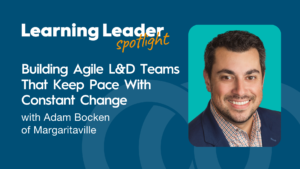
In an era where learning and development must balance speed, accessibility, and purpose, this episode of Learning Leader Spotlight centers squarely on agility as a strategic capability. Adam Bocken, Vice President of Training and Development at Margaritaville, joins host Leigh Anne Lankford for a candid conversation about how modern L&D organizations adapt to rapid change while ensuring learning contributes meaningfully to business performance. Drawing on nearly two decades of experience within the global hospitality brand, Adam offers a grounded perspective on the intersection of experience design, operational rhythm, technology, and team capability.
What emerges from the discussion is a practical and humanized view of L&D, one that treats training not as a one-time event, but as an evergreen process tightly woven into organizational culture and business outcomes.
A Career Forged Through Experience and Operational Learning
Adam’s path into corporate learning reflects a pattern familiar to many L&D professionals. The journey began on the ground, rooted in training roles that were deeply operational and interaction-based. Early work in frontline training exposed him to the realities of adult learning, including how people absorb, apply, and retain knowledge differently depending on context, relevance, and timing.
Over time, Adam’s role expanded beyond classroom delivery into strategy, design, and systems thinking. This progression mirrors the broader maturation of the L&D function across industries. The shift from trainer to learning strategist required new skills, including understanding business rhythm, aligning with operational goals, and evaluating learning impact against meaningful metrics rather than participation alone.

Creating Performance & Learning Objectives That Drive Results
Learning as an Experience, Not a Transaction
A central theme of the conversation is how Margaritaville approaches learning as part of the brand and guest experience. For Adam, consistent team member experience means more than one-off training modules. It requires coherence in how learning reinforces brand values, service expectations, and employee development.
Several insights emerged here:
- Consistency across touchpoints is critical in hospitality. Learning teams must work in lockstep with operations, guest services, and performance standards to ensure what’s taught is what’s lived.
- On-demand accessibility is no longer optional. Learners expect training where they are, when they need it, and in formats that meet diverse preferences, from microlearning bites to immersive facilitator-led sessions.
Adam describes this not as a technology problem, but as an experience design challenge. The question becomes how to ensure learning supports real-world performance without becoming overwhelming or disconnected from day-to-day work.
Technology, AI, and Judgment
The episode explores the role of technology, particularly AI, in shaping how work gets done and how learning supports that change. Adam shares a nuanced view. AI is not here to eliminate roles, but to change the nature of work by automating repetitive tasks while elevating judgment, creativity, and human connection.
Key takeaways include:
- AI as an augmenter: When thoughtfully applied, tools powered by artificial intelligence can accelerate content creation, personalize learning pathways, and free up L&D professionals to focus on strategic impact.
- Judgment over generation: The value shift is from generating outputs to evaluating and contextualizing them. The ability to discern whether AI-produced content is accurate, relevant, and aligned with organizational goals becomes a defining skill.
Adam emphasizes that technology should support learning in service of performance, not lead it. The strongest outcomes occur when human insight and technological capability are intentionally combined.
Adaptability as a Core Capability
Throughout the conversation, Adam returns to adaptability as the defining capability for L&D teams today. Rapid change, whether driven by new tools, business models, or learner expectations, demands that learning organizations not just pivot, but pivot with purpose.
This includes:
- Continuous iteration: Rather than waiting for perfect designs, teams should encourage rapid prototyping of learning solutions, gather real-time feedback, and refine based on evidence of impact.
- Cross-functional collaboration: Learning teams that work closely with HR, operations, technology, and business leaders are better positioned to anticipate change and co-design solutions that stick.
- Mindset over method: Technical skills matter, but mindset, especially curiosity, experimentation, and learner empathy, differentiates teams that thrive from those that lag.
Adam’s perspective aligns with a broader shift in L&D. Success lies not in resisting change, but in building teams and structures that are inherently responsive and aligned to dynamic organizational priorities.
Practical Takeaways for L&D Leaders
The latter part of the episode focuses on actionable guidance:
- Treat learning as an ongoing process, not a series of events. Programs should be evaluated by their contribution to performance and behavior change, not attendance or completion rates.
- Build agility into your workflow. Create mechanisms for rapid feedback, iteration, and cross-team coordination so learning solutions evolve alongside business needs.
- Cultivate judgment and adaptability. Invest in capabilities that help teams discern quality, align to strategic imperatives, and design with both speed and relevance.
These influences reinforce his belief that L&D must remain curious, informed, and grounded in real business contexts.
Is Your L&D Team Built for Scale?
Resources and Influences Discussed
Throughout the conversation, Adam referenced a mix of platforms, publications, and foundational texts that shape how he thinks about learning strategy, performance, and leadership. Together, these resources reinforce a recurring theme of the episode: effective learning leaders draw from multiple disciplines and stay anchored in both business reality and human experience.
- He cited professional organizations like ATD and SHRM as ongoing sources of research, trends, and practitioner perspectives.
- Publications such as Harvard Business Review help him stay connected to broader conversations around leadership, strategy, and organizational effectiveness, ensuring learning decisions are informed by business context, not just L&D best practices.
When it comes to foundational frameworks and books, Adam highlighted several that continue to influence his approach.
- He pointed to Good to Great by Jim Collins as a lens for understanding adaptability, leadership discipline, and long-term organizational success.
- More recently, Unreasonable Hospitality by Will Guidara resonated with him as a powerful reframing of service, care, and experience, themes that align closely with both hospitality and internal learning organizations.
Finally, Adam acknowledged the influence of well-known leadership thinkers like Simon Sinek and John Maxwell, whose work continues to inform how leaders communicate purpose, build trust, and develop others.
Taken together, these resources reflect a learning philosophy rooted in performance, adaptability, and service. They underscore Adam’s belief that strong L&D leadership is not about mastering a single model or tool, but about continually learning across domains and applying those insights in ways that support both people and business outcomes.
Ready to Work with Us?
Does your L&D team have more projects than people? TrainingPros has been named a Top 20 Staffing Company internationally by Training Industry, and recognized as a Smartchoice® Preferred Provider by Brandon Hall Group for 2025. We’re also proud to be named a Champion of Learning by the Association for Talent Development (ATD)—an international honor that reflects our dedication to excellence in corporate learning. These accolades underscore TrainingPros’ unwavering commitment to delivering high-quality, tailored training solutions.
If your projects need instructional design consultants, eLearning developers, or other learning & development consultants for your custom content projects, reach out to one of our industry-expert relationship managers today.
When you have more projects than people™, let TrainingPros find the right consultant to start your project with confidence. Schedule a consultation today.