Engaging What Matters in Modern L&D: Insights from Adam Morettin of U.S. Renal Care
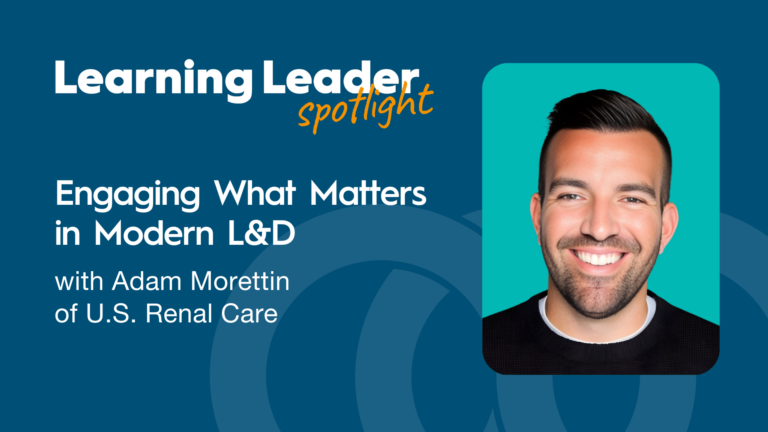
This episode of Learning Leader Spotlight examines what it means to design learning experiences that truly matter in a modern workplace defined by rapid change, new technologies, and shifting learner expectations. Guest host Chenier Mershon speaks with Adam Morettin, Group Vice President of Learning and Development at U.S. Renal Care, about the evolution of the L&D profession, the innovations reshaping instructional design, and the practical realities of leading large-scale learning initiatives. Their conversation offers a grounded look at how learning leaders can remain effective in a world where relevance, personalization, and speed are increasingly critical.
Adam Morettin serves as Group Vice President of Learning and Development at U.S. Renal Care, the third-largest outpatient dialysis provider in the world. He co-leads learning efforts for both clinical and leadership development, supporting approximately 10,000 team members across about 500 centers in the United States and the Middle East. His work focuses on ensuring a strong team member experience and fostering professional growth that influences both workplace performance and personal impact.
The Expanding Role of AI in Learning and Development
One of the most prominent themes in the conversation is the transformational effect of artificial intelligence on learning design and delivery. Adam emphasizes that AI has radically accelerated the creation of learning content that previously required extensive time, manual effort, and collaboration with subject matter experts.
With AI-generated coursework becoming both fast and effective, instructional design processes can now operate at a pace that meets organizational demands more efficiently. He notes that AI will continue advancing and will not remain limited to content generation. Emerging AI coaching tools now simulate interactive, natural-feeling dialogues, enabling learners to practice skills or explore topics in a conversational format.
This evolution, he observes, mirrors the growing integration of AI in everyday life, from home assistants to productivity tools. For Adam, AI’s trajectory signals an opportunity for L&D to create more dynamic, responsive experiences that align with how people already interact with technology.

Learning Trends Shaping the Future – What Learning Leaders See Coming Next
The Rise of Snackable, On-Demand Learning Content
Another major shift Adam highlights is the movement toward concise, focused learning experiences that match the consumption patterns of modern audiences. Drawing parallels to short-form digital media, he explains that learners no longer want lengthy paths to basic information.
Instead, they prefer immediate answers that respect their time and allow them to apply knowledge quickly. Rather than one-hour modules, learners benefit from five-minute micro-content that offers exactly what is needed. This shift reflects broader societal patterns in information‑seeking behavior. Adam illustrates this with everyday examples, such as using Google or YouTube for quick how‑to guidance rather than sifting through detailed manuals.
For L&D teams, the implication is clear: the traditional model of lengthy, comprehensive learning experiences increasingly competes with learners’ desire for frictionless, targeted instruction.
The Importance of Personal, Emotional, and Targeted Learning Experiences
A central message throughout the episode is that memorable learning must be intentionally designed to connect with the learner in meaningful ways. Adam stresses that personalization is essential for relevance. Without tailoring content to an individual’s needs, the learning becomes noise in an already noisy world.
He also underscores the power of emotion in creating lasting impressions. Even in topics that may seem dry or technical, emotional engagement helps form the mental connections that allow ideas to stick. This emotion can be positive, but it can also surface through challenge or discomfort if designed thoughtfully.
The final component, targeted specificity, ensures that learners receive content that directly relates to their context, eliminating wasted time and cognitive overload. When these three elements converge, learning shifts from routine information delivery to an experience that remains in memory and influences behavior.
Designing Experiential Learning That Creates Memorable Moments
To illustrate how personal, emotional, and targeted elements can come together, Adam shares examples from his own practice. One example involves an instructor-led group activity where participants are blindfolded and asked to accomplish a task with minimal direction. The exercise generates initial chaos and discomfort, which becomes a catalyst for learning. As the group begins organizing itself, natural leaders emerge, communication patterns form, and collaboration improves.
The powerful moment, however, occurs during the debrief, where participants examine how the experience connects to communication, leadership, team dynamics, and strategy. The emotional intensity of the blindfolded activity, combined with the relevance of the reflection, makes the lesson memorable. Adam notes that this activity is effective across different cultural contexts and consistently yields meaningful insights.
His second example involves a leadership program structured around organization‑wide engagement survey metrics. Instead of a broad, generalized curriculum, leaders are assigned learning tracks that target development areas indicated by their own teams. For instance, if a leader scores lower in recognition, they attend a virtual instructor-led session on that topic and then move through a curated learning journey focused exclusively on recognition.
This program combines personalization with measurable outcomes by comparing pre-program benchmarks to subsequent engagement survey results. The targeted approach allowed leaders to focus energy where it mattered most, and the data showed improvement among those who engaged in these specialized tracks.
Through these examples, Adam reinforces the idea that memorable learning emerges not from the format itself, but from alignment between experience, emotional investment, and relevance.
Measuring Learning Impact Through Behavior and Perception
When discussing metrics, Adam acknowledges that L&D professionals often struggle with measurement, particularly because many come from creative backgrounds rather than analytical disciplines. However, he describes a structured approach that moves beyond traditional satisfaction surveys. He begins with basic evaluation of the learner’s experience but recognizes that executives may not prioritize these metrics. More substantial measures involve assessing proficiency through tests or structured assessments that benchmark knowledge or skills before and after a learning program.
Even more significant, though, is behavioral measurement. Adam highlights the power of using engagement survey feedback as a way to determine whether learning translates into meaningful behavioral changes. In the leadership development example he shared, learners’ teams effectively serve as the evaluators, assessing whether the leader’s development area has improved over time. This kind of behavioral evidence, grounded in day-to-day interactions rather than isolated knowledge checks, provides a clearer view of whether learning has truly resulted in change.
The Evolving Landscape of Mobile and Social Learning
Though not yet fully realized in his own organization, Adam points to mobile learning as an essential future direction. He notes that many organizations are already far along in developing mobile-first approaches, and meeting learners in the environments where they naturally work will only grow in importance.
Social learning is another frontier he identifies, though one with complexities for highly regulated industries. While social platforms mirror how people share information outside of work, there is risk when informal channels spread incorrect or unverified practices in a clinical setting.
Despite these challenges, Adam acknowledges that social learning will likely continue to grow and that organizations must find safe and structured ways to support this trend.
The Power of Peer Networks and Vendor Conversations for Continuous Learning
Throughout the conversation, Adam mentions that some of the richest learning experiences come not from formal training or conference presentations, but from peer connections and interactions with vendors. He attends one or two conferences per year, not primarily for the keynote content but for the informal conversations that happen around them.
In these discussions, he learns how others are solving similar challenges, gains exposure to innovative ideas, and discovers new approaches to common L&D issues. Adam also values vendor demonstrations, even when he is not purchasing a product. Vendors often share concepts, features, or models that spark new ideas for internal programs, many of which can be adapted without buying anything new.
This openness to learning from the surrounding ecosystem reflects his emphasis on curiosity and continuous improvement.
Elements of a Learning Journey for Instructional Designers
Practical Takeaways for L&D and Business Leaders
1. Leverage AI to Accelerate Content Development and Enable New Learning Modalities
AI allows teams to produce high-quality content quickly and consistently. As AI tools evolve to include conversational coaching and interactive simulations, leaders may consider how these capabilities can support skill building, reduce development time, and create more personalized learning experiences.
2. Prioritize Short, Targeted Learning That Fits Modern Consumption Patterns
Bite-size modules, micro-videos, and topical learning pathways align with how learners access information outside the workplace. By providing concise content that eliminates unnecessary steps, organizations improve both relevance and retention.
3. Build Learning Journeys That Are Personalized, Emotionally Resonant, and Contextually Relevant
Combining personalization with emotional engagement creates stronger memory and application. Programs tailored to the learner’s role, performance feedback, or development needs increase the likelihood of lasting impact. Experiences that evoke emotion can deepen reflection and drive behavioral change.
4. Use Behavioral and Perception-Based Metrics to Assess Real Impact
Pre- and post-assessments offer insight into knowledge gains, but long-term effectiveness shows up in learner behavior. Engagement surveys, observation, and team feedback can help validate whether learning translates into improved actions, leadership practices, or workplace relationships.
5. Embrace Peer Learning and Cross‑Industry Conversations for Ongoing Idea Generation
Conversations that occur in informal settings or through vendor interactions can be rich sources of innovation. Learning leaders benefit from cultivating networks where they can ask targeted questions, share challenges, and learn how others are approaching similar problems.
Closing Reflection
The episode reinforces that impactful learning in today’s environment requires adaptability, curiosity, and a commitment to designing experiences that genuinely resonate with learners. From AI-enabled innovation to emotionally grounded experiential design, the future of L&D centers on meeting people where they are while ensuring learning remains meaningful, practical, and tied to real-world behaviors. Adam’s perspective highlights what is possible when learning leaders balance creativity with disciplined measurement and a deep understanding of the people they serve.
Ready to Work with Us?
Does your L&D team have more projects than people? TrainingPros has been named a Top 20 Staffing Company internationally by Training Industry, and recognized as a Smartchoice® Preferred Provider by Brandon Hall Group for 2025. We’re also proud to be named a Champion of Learning by the Association for Talent Development (ATD)—an international honor that reflects our dedication to excellence in corporate learning. These accolades underscore TrainingPros’ unwavering commitment to delivering high-quality, tailored training solutions.
If your projects need instructional design consultants, eLearning developers, or other learning & development consultants for your custom content projects, reach out to one of our industry-expert relationship managers today.
When you have more projects than people™, let TrainingPros find the right consultant to start your project with confidence. Schedule a consultation today.