Why L&D is Now Your Company’s Competitive Advantage with Brandon Carson, Chief Learning Officer and Founder of L&D Cares
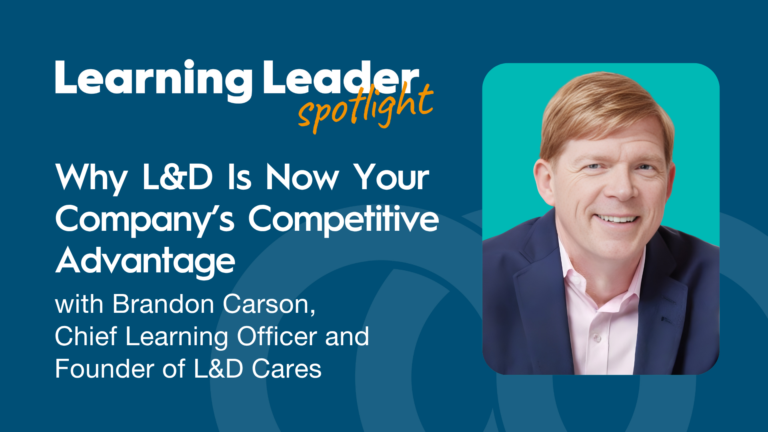
In this milestone 100th episode of Learning Leader Spotlight, Brandon Carson, chief learning officer and founder of L&D Cares sits down with host Leigh Anne Langford to explore how learning and development must evolve as artificial intelligence reshapes work itself. Rather than focusing on incremental improvements to training, the conversation challenges L&D leaders to rethink their role in enabling performance, decision-making, and organizational development. The episode offers a candid, future-oriented perspective on what it will take for learning organizations to remain relevant and valuable.
Brandon Carson is a globally recognized leader in learning and development. He is the author of multiple books, including The L&D’s Playbook for the Digital Age. Drawing on decades of experience across large, complex organizations, Brandon brings a systems-level view of how learning, work, and leadership intersect, particularly in periods of major transformation driven by technology and changing workforce expectations.
From Learning Function to Work System
One of the most significant shifts Brandon highlights is the movement of learning out of standalone programs and into the flow of work itself. Traditional L&D models often optimize learning as an overlay, relying on courses, academies, and dedicated platforms. In contrast, the emerging model embeds learning directly into how work gets done.
Artificial intelligence accelerates this shift by enabling real-time augmentation. Rather than training people in advance for every possible scenario, AI-supported systems can deliver guidance, insights, and context at the moment of need, true learning in the flow of work. Brandon connects this evolution to long-standing ideas in performance support, noting that while the concept is not new, AI dramatically expands its reach and adaptability.

How To Design Effective Instructor-Led Training (ILT)
The Collapse of the Course as the Primary Unit of Value
Courses have long been the default output of L&D, with success measured through completions and satisfaction scores. Brandon argues that this model is rapidly losing relevance. AI now allows content to be generated almost instantly, driving the marginal cost and perceived value of content creation toward zero.
As a result, L&D must move beyond being a “content factory.” The future focus shifts to supporting decision-making, providing judgment scaffolding, and enabling augmented performance engines. In this new landscape, L&D exits the content business and enters the workforce capability business, with success defined by how effectively people perform, not how much content they consume.
Rewiring the Work Operating Model
A recurring theme in the episode is the need to rethink the foundational operating model of work. Many organizations still rely on principles rooted in the manufacturing age, emphasizing standardization, repeatability, and centralized control. Brandon explains that AI introduces continuous change, role fluidity, and skills volatility, making those models increasingly ineffective.
To remain competitive, organizations must become true learning companies where learning is continuous, embedded, and democratized, yet governed. This transformation requires reimagining performance management systems that have been in place for decades and integrating learning across both digital and physical work environments.
AI in Corporate Learning: What Learning Leaders Are Saying in 2026
L&D as a Value Creator, Not a Support Function
Brandon places the current moment in historical context by revisiting the original intent behind the chief learning officer role. When the position was created at GE in the mid-1990s, it was designed to directly support enterprise transformation and reported to the CEO. Over time, L&D has often been relegated to a support function, funded as a cost center and treated as a service desk responding to requests from the business.
Reframing L&D as a value creator requires a fundamental shift in accountability. Instead of being measured by activity, L&D must be responsible for building enterprise-critical capability and influencing business performance. This includes owning capability for enterprise-critical roles and having a seat at the table where workforce and strategic decisions are made.
Leadership in an Intelligence-Driven Organization
As learning becomes the architecture through which intelligence flows, leaders’ roles change dramatically. Managers are no longer simply consumers of training products; they are designers of the conditions under which learning and decision-making occur.
Brandon emphasizes that the most important learning experience in an organization may be the last decision someone made. In this context, leadership effectiveness is defined less by personal expertise and more by the ability to help teams think and act intelligently in real time. Leaders must balance trust in AI with human accountability, ensuring that people remain “human-in-the-lead” even as intelligent systems become more agentic.
Skills-First Strategies and the Risk of Dehumanization
The conversation also explores the rapid adoption of skills-first approaches. Brandon agrees that moving toward skills is directionally right, particularly for increasing visibility, mobility, and opportunity. However, he cautions against starting with technology and reducing people to collections of discrete skills.
To counter this risk, he introduces the BVAC model: Belief, Visibility, Access, and Connection. This framework emphasizes keeping the human experience at the center, accounting for context, judgment, identity, prior experience, and aspiration. Skills strategies, he argues, succeed because of organizational culture, not because of taxonomies or platforms alone.
Middle Managers as the Linchpin of Transformation
Another critical insight is the outsized role of first- and middle-level managers in this era of change. Senior executives often lack visibility into how work actually gets done, while managers closest to the work shape how intelligence and learning show up day to day.
Leaders must move away from “leader as expert” and “leader as sole decision-maker” mindsets. Instead, they must become facilitators of learning in motion, comfortable letting go of control and redesigning work to accommodate continuous learning and adaptation.
Practical Takeaways for L&D and Business Leaders
- Embed learning into work, not alongside it. Focus on performance support and real-time augmentation rather than relying solely on courses and programs.
- Redefine success metrics. Shift from measuring activity, such as completions and satisfaction scores, to measuring capability and performance outcomes tied to business priorities.
- Design for human accountability in AI-enabled systems. Ensure that humans remain responsible for decisions, even as AI provides recommendations or automation.
- Approach skills strategies with humanity first. Use skills frameworks to expand opportunity and mobility while preserving context, aspiration, and identity.
- Invest in manager capability. Equip first- and middle-level managers to design learning conditions, allocate time to learn, and learning in the flow of work.
Resources and Frameworks Mentioned
- The L&D’s Playbook for the Digital Age by Brandon Carson
- L&D Cares
Related Reading and Episodes
Brandon Carson has also partnered with Markus Bernhardt to co-author a seven-article series titled “The AI-Powered Workforce.” The series presents six strategic actions that executive teams should take to prepare L&D for the age of AI.
Listeners interested in a complementary perspective can also listen to Markus Bernhardt’s episode of Learning Leader Spotlight, where he explains how leaders can distinguish between tactical AI adoption and deeper structural change.
Closing Reflection
This episode with Brandon Carson underscores that the future of learning is inseparable from the future of work. As AI reshapes how decisions are made and value is created, L&D leaders are uniquely positioned to act as catalysts for transformation, provided they are willing to move beyond familiar models. The challenge Brandon leaves listeners with is both simple and uncomfortable: if learning disappeared tomorrow, what would truly break, and what does that reveal about its current impact?
A Big Thank You
Reaching 100 episodes of Learning Leader Spotlight is an important milestone, and it would not be possible without the generosity, curiosity, and commitment of this community. To every listener who has tuned in, shared an episode, reflected on a question, or applied an idea back in their organization, thank you for being part of this journey. This podcast exists to serve our learning community, and its longevity is a reflection of the conversations that continue to matter in our profession.
Equal appreciation goes to the guests who have joined the show over the past 100 episodes. Each learning leader has taken time to share not just successes, but uncertainty, lessons learned, and honest perspectives on the evolving role of learning and development. Those insights have helped shape thoughtful dialogue across the field and provided learning leaders with practical ways to navigate change in their own organizations.
As the world of work continues to shift, this podcast remains committed to elevating voices that challenge assumptions, expand thinking, and push the profession forward. Episode 100 is both a celebration of how far the community has come and an invitation to continue learning together in what lies ahead.
Ready to Work with Us?
Does your L&D team have more projects than people? At TrainingPros, we match organizations with experienced consultants who lead with strategy, so you can connect learning decisions to real business goals. We support teams across compliance, customer service, leadership and supervisory development, product knowledge, and sales, as well as information technology, software, and learning platforms. Whether you’re rethinking onboarding, scaling a program, or upgrading the tools behind it, we help you move from reactive delivery to results-driven capability building.
TrainingPros has been named a Top 20 Staffing Company internationally by Training Industry, and recognized as a Smartchoice® Preferred Provider by Brandon Hall Group for 2025. We’re also proud to be named a Champion of Learning by the Association for Talent Development (ATD)—an international honor that reflects our dedication to excellence in corporate learning. These accolades underscore TrainingPros’ unwavering commitment to delivering high-quality, tailored training solutions.
If your projects need instructional design consultants, eLearning developers, or other learning & development consultants for your custom content projects, reach out to one of our industry-expert relationship managers today.