Keeping the Human in L&D While Embracing AI with Dr. Darick Bryant of Clean Harbors
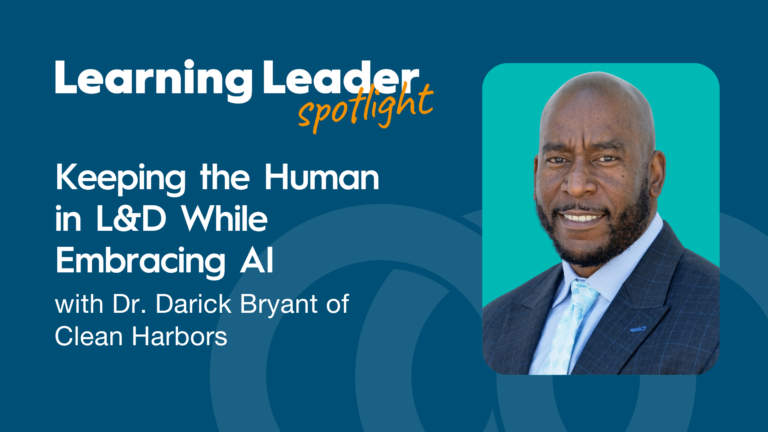
In this episode of Learning Leader Spotlight, Dr. Darick Bryant of Clean Harbors joins host Leigh Anne Lankford of TrainingPros on the evolving role of learning and development in a rapidly changing workplace. The conversation explores how technology, generational shifts, and empathy are reshaping leadership expectations. Throughout the episode, Darick emphasizes a central idea: the future of L&D must balance innovation with humanity.
Dr. Darick Bryant serves as Director of Learning and Organizational Development at Clean Harbors, an industry leader in environmental and industrial services with a global workforce of more than 24,000 employees. His career spans operational leadership and enterprise-wide development initiatives, giving him a practical, business-grounded perspective on learning strategy. Darick’s path into L&D was shaped by hands-on leadership experience and later reinforced through advanced academic study in organizational and strategic leadership.
Technology Has Transformed How
Learning Is Delivered, Not Why It Exists
Darick points to technology as the most visible change in learning and development over recent years, accelerated by the global pandemic. Organizations have moved from primarily instructor-led training to a blended learning model that includes virtual classrooms and self-directed learning. While these modalities have expanded reach and accessibility, Darick stresses that the core purpose of learning remains unchanged: enabling people to grow and perform. The challenge for L&D leaders lies in designing flexible learning pathways that respect individual preferences while aligning with organizational goals.

Learning Trends Shaping the Future
AI Must Enhance, Not Dehumanize, Learning and Development
Artificial intelligence features prominently in the conversation, with Darick offering a measured and cautionary perspective. While AI can automate administrative tasks and improve efficiency, he warns against allowing it to strip learning of its human dimension. Automation should free L&D professionals to focus on higher-value work such as coaching, mentoring, and relationship-building. Darick frames AI as a tool that, if used thoughtfully, can amplify impact rather than replace the human elements that make learning meaningful.
Learning as a Retention Strategy for Emerging Generations
As baby boomers exit the workforce and Gen X leaders begin to approach retirement, Darick highlights the growing importance of L&D as a retention and engagement strategy for millennials and Gen Z employees. These generations, he notes, often view careers differently, valuing development, autonomy, and purpose over long-term tenure alone. Clear development frameworks and visible career pathways help communicate that an organization values its people and is invested in their future.
Succession Planning Requires Honest
Conversations About Growth
Succession planning emerges as a critical priority given generational turnover. Darick emphasizes the need for transparent conversations about what advancement looks like and the time required to achieve it. While some aspects of modern life encourage immediate results, leadership development remains a process. Helping employees understand that growth unfolds over time allows them to make informed decisions about their commitment to the organization.
Empathy Is No Longer a “Soft Skill” but
a Core Leadership Competency
Darick challenges the outdated notion of “soft skills,” arguing that empathy and emotional intelligence are essential competencies for today’s leaders. The ability to understand what individuals need from their leaders directly influences engagement and performance. He connects empathy to inclusion, noting that leaders must recognize and adapt to differences in personality, experience, and neurodiversity. Leading humans, rather than roles or outputs alone, is positioned as a defining requirement of effective leadership.
Practical Takeaways for L&D and Business Leaders
Design Learning Ecosystems, Not Single Programs
Leaders are encouraged to move beyond one-size-fits-all training and instead build learning ecosystems that incorporate multimodal learning. Blended approaches allow organizations to meet diverse learner needs while maintaining consistency and scale.
Use AI to Reallocate Human Effort, Not Replace It
When integrating AI, organizations should focus on using automation to reduce low-value tasks. The time gained can then be reinvested in coaching, relationship-building, and strategic development work that requires human judgment and empathy.
Make Development Pathways Visible to Younger Employees
Clear, communicated development frameworks help younger generations understand how they can grow within the organization. Visibility into future opportunities reinforces commitment and positions learning as a shared investment.
Normalize Conversations About Time and Process in Career Growth
L&D leaders play a role in setting realistic expectations about advancement. Honest discussions about timelines and required experiences help employees decide whether they are willing to engage in the development journey.
Elevate Empathy as a Leadership Standard
Empathy should be treated as a core competency, not an optional trait. Developing leaders’ emotional intelligence strengthens inclusion, improves team dynamics, and reduces organizational risk associated with disengagement or misunderstanding.
Resources and Tools Mentioned
- Podcasts from John Maxwell
- Research and articles from Harvard Business Review
- Professional learning via LinkedIn Learning
- Leaders Made Here by Mark Miller, recommended for building sustainable leadership pipelines
Closing Reflection
This episode underscores that while tools, technologies, and workforce demographics will continue to evolve, the heart of learning and development remains unchanged. Darick’s perspective reinforces that L&D is both a strategic function and a human-centered practice. By balancing innovation with empathy and clarity, organizations can build leaders and cultures prepared for the future.
Ready to Work with Us?
Does your L&D team have more projects than people? At TrainingPros, we match organizations with experienced consultants who lead with strategy, so you can connect learning decisions to real business goals. We support teams across compliance, customer service, leadership and supervisory development, product knowledge, and sales, as well as information technology, software, and learning platforms. Whether you’re rethinking onboarding, scaling a program, or upgrading the tools behind it, we help you move from reactive delivery to results-driven capability building.
TrainingPros has been named a Top 20 Staffing Company internationally by Training Industry, and recognized as a Smartchoice® Preferred Provider by Brandon Hall Group for 2025. We’re also proud to be named a Champion of Learning by the Association for Talent Development (ATD)—an international honor that reflects our dedication to excellence in corporate learning. These accolades underscore TrainingPros’ unwavering commitment to delivering high-quality, tailored training solutions.
If your projects need instructional design consultants, eLearning developers, or other learning & development consultants for your custom content projects, reach out to one of our industry-expert relationship managers today.
When you have more projects than people™, let TrainingPros find the right consultant to start your project with confidence. Schedule a consultation today.