Why a Learner Mindset Beats Any Skill in Leadership Development with Anita Zanchettin of DoorDash
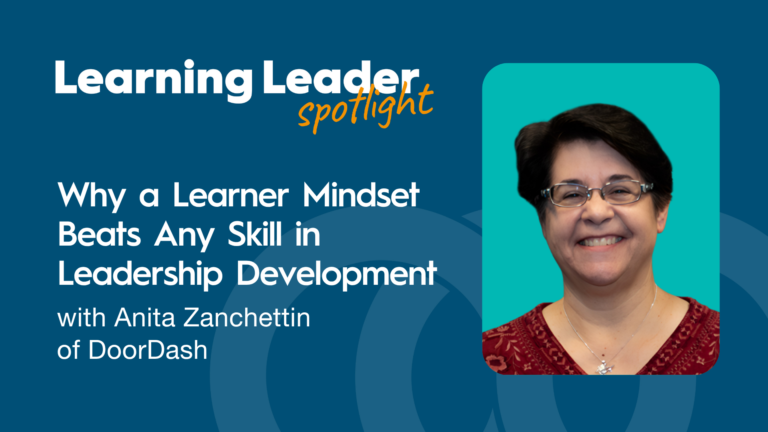
In this episode of Learning Leader Spotlight, host Leigh Anne Lankford speaks with Anita Zanchettin, Director of Talent Development at DoorDash, about how leadership development is evolving in an environment defined by speed, complexity, and constant change. The conversation explores what it means to design learning that truly serves leaders today and how talent development functions can increase their impact by staying close to the realities of leadership work. Throughout the discussion, Anita brings a thoughtful, systems-oriented perspective shaped by global experience and a strong belief in leaders as drivers of organizational culture and performance.
Anita Zanchettin leads leadership and talent development globally across DoorDash and its international brands, including Wolt and Deliveroo. Her work centers on supporting leaders as the primary customers of talent development and strengthening leadership capability as a lever for organizational impact. With a background in languages, intercultural leadership, and global consulting, Anita brings a cross-cultural and enterprise-wide lens to learning and development.
Leaders as the Core Customer of Talent Development
A central theme in the conversation is Anita’s belief that leaders are the primary customers of talent development. Rather than designing programs in isolation, she emphasizes the importance of deeply understanding leaders’ day-to-day realities. The pace of work, level of ambiguity, and breadth of responsibility leaders face today are significantly different from even a few years ago. For talent development to be effective, it must be grounded in those realities.
Anita frames leaders as force multipliers within organizations. Strong leaders shape culture, role-model behaviors, develop others, and influence outcomes far beyond their immediate teams. From this perspective, investing in leadership capability is not just about individual development, but about amplifying impact across the enterprise.
Development as Experience, Not Events
Another recurring theme is the shift away from viewing development as discrete events or programs. Anita reinforces the idea that growth happens through experience, feedback, and iteration. Leaders develop by being stretched into challenging situations, receiving feedback, and improving over time.
This philosophy shows up both in how Anita describes her own career development and in how she designs learning for others. Formal learning programs have a role, but they are not sufficient on their own. Real development requires exposure to real work and the opportunity to practice leadership skills in context.
Learning in the Flow of Work
Anita highlights the importance of embedding learning directly into leaders’ workflows. Given the limited time leaders have, development must show up at the moment of need rather than as an additional task. She describes examples from DoorDash where leaders receive targeted guidance while writing feedback or reviewing engagement survey results, enabling development to happen in real time.
This approach reflects a broader shift in learning and development toward just-in-time, contextual support. Instead of asking leaders to step away from work to learn, learning is integrated into the tools and processes they already use.
Progress Over Activity and Stronger Measurement
The conversation also touches on how measurement in talent development has matured. Anita references a mentor’s advice that development is not about activities, but about progress. This mindset drives a stronger focus on both input metrics, such as satisfaction and perceived learning, and output metrics, such as retention of top talent.
By focusing on progress rather than participation, talent development functions can better demonstrate their value and align their efforts with business outcomes. This shift also supports more intentional prioritization, helping teams decide where to invest their time and resources.
The Dual Future of Leadership Development
Looking ahead, Anita describes two seemingly opposite but complementary directions for leadership development. On one end is hyper personalized learning, enabled in large part by AI. This includes highly tailored support based on an individual leader’s context, data, and immediate needs.
On the other end is a growing emphasis on enterprise leadership capability. Leaders are being asked to think beyond their functional silos, connect the dots across geographies and functions, and operate as enterprise leaders rather than narrow subject matter experts. Development, in this sense, is about helping leaders go deeper in self-awareness while also going broader in perspective and influence.
Practical Takeaways for L&D and Business Leaders
Stay Close to Leaders’ Real Work
Talent development leaders can increase their impact by spending more time understanding the lived experience of leaders. This includes their pressures, constraints, and decision-making environments. Designing learning from this advantage helps ensure relevance and adoption.
Design Development as a Continuous Experience
Effective leadership development extends beyond programs and workshops. Stretch assignments, real-world challenges, and ongoing feedback loops are critical components of growth. Development efforts should prioritize experiences that help leaders build capability over time.
Embed Learning Into Daily Tools and Moments
Learning in the flow of work enables leaders to apply new insights immediately. Providing guidance at moments such as performance feedback, engagement review, or change management increases the likelihood that learning translates into behavioral change.
Measure What Matters
Shifting the focus from activity to progress allows L&D teams to demonstrate impact more clearly. Combining input and output metrics supports more meaningful conversations with stakeholders about what is working and where to adjust.
Cultivate a Learner Mindset and Fungibility
Rather than emphasizing a single critical skill, Anita points to mindset as the most important capability in today’s workplace. Leaders who remain curious, adaptable, and willing to stretch into new roles are better equipped to navigate constant change. Talent development can support this by normalizing learning, experimentation, and growth at all career stages.

How To Design Effective Instructor-Led Training (ILT)
Resources or Tools Mentioned
The Medici Effect: Breakthrough Insights at the Intersection of Ideas, Concepts, and Cultures by Frans Johansson
Closing Reflection
This episode underscores a vision of leadership development that is both deeply human and strategically grounded. By treating leaders as customers, embedding learning into real work, and focusing on adaptability over static skill sets, talent development functions can better serve organizations navigating continuous change. Anita Zanchettin’s perspective offers a clear reminder that the most powerful development happens when leaders are stretched, supported, and encouraged to keep learning.
Ready to Work with Us?
Does your L&D team have more projects than people? At TrainingPros, we match organizations with experienced consultants who lead with strategy, so you can connect learning decisions to real business goals. We support teams across compliance, customer service, leadership and supervisory development, product knowledge, and sales, as well as information technology, software, and learning platforms. Whether you’re rethinking onboarding, scaling a program, or upgrading the tools behind it, we help you move from reactive delivery to results-driven capability building.
TrainingPros has been named a Top 20 Staffing Company internationally by Training Industry, and recognized as a Smartchoice® Preferred Provider by Brandon Hall Group for 2025. We’re also proud to be named a Champion of Learning by the Association for Talent Development (ATD)—an international honor that reflects our dedication to excellence in corporate learning. These accolades underscore TrainingPros’ unwavering commitment to delivering high-quality, tailored training solutions.
If your projects need instructional design consultants, eLearning developers, or other learning & development consultants for your custom content projects, reach out to one of our industry-expert relationship managers today.
When you have more projects than people™, let TrainingPros find the right consultant to start your project with confidence.