From Live Training to On-Demand Learning with Kimberly Hill of Nielsen
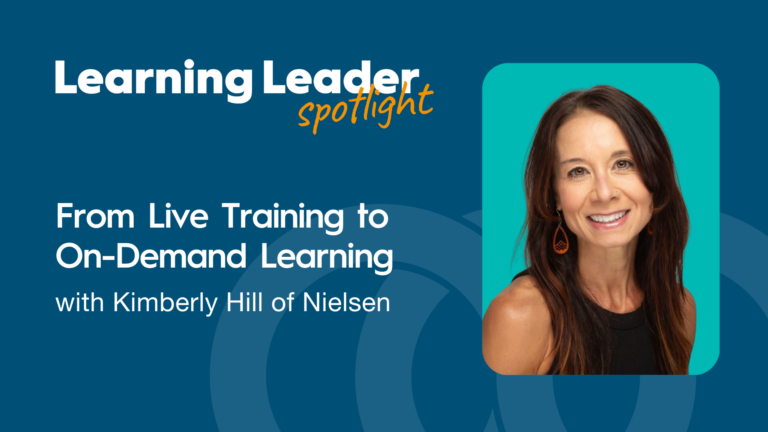
This episode of Learning Leaders Spotlight features a conversation with Kimberly Hill, Senior Director of Global Client Learning at Nielsen. The discussion centers on how learning teams, especially those supporting customers at scale, are adjusting to rapid changes in both technology and learner expectations. Kimberly describes the shift from traditional, live, instructor-led delivery toward a more flexible on-demand model built around microlearning, certification, and measurable accountability. Throughout the interview, she emphasizes the practical reality that today’s learners consume information differently than they did even a few years ago and that effective learning design needs to reflect those habits without losing depth or rigor.
Kimberly Hill leads global client learning at Nielsen, a company widely known for TV ratings. Kimberly explains that Nielsen’s work spans mobile devices, tablets, television, cinema, audio, and viewing that happens through social platforms and services such as YouTube. Because audience behavior is global, her organization supports users around the world who need to interpret and apply Nielsen’s data in their own business contexts.
In practice, this means helping customers not only pull the right numbers from Nielsen tools, but also use those numbers to answer business questions, such as how many people are consuming specific content, how audience behavior differs by platform, and how performance compares against competitors. Kimberly frames client learning as part of customer experience and customer success: training is not separate from outcomes, but a key mechanism for driving adoption, renewals, and value realization.
1. The Changing Nature of Media and Its Impact on Learning
Kimberly repeatedly connects the learning challenge to the same forces reshaping media itself. She invites listeners to think about how their own media habits have shifted over time. People once watched whatever was on at the time it aired, but now expect to consume content when and where they choose, often across multiple devices. Kimberly notes that Nielsen’s customers face a rapidly evolving measurement landscape because audiences no longer sit in one place, on one screen, at one predictable time. As a result, customer education has to cover both the mechanics of extracting data and the concepts behind what the data represents in a fragmented environment.
In the interview, Kimberly explains that software training alone is insufficient. Her teams still teach the “true button pushing” needed to run reports and pull audience numbers, but she sees the most important work as helping users understand what to do with the output. She describes this as moving into the “stories” the data tells, why particular audiences matter, what trends imply, and how insights can be translated into decisions that help customers make money, increase audience share, or improve advertising and content strategies. That blend of technical instruction plus interpretation is especially important when the underlying industry changes so quickly that yesterday’s assumptions about viewing behavior may not hold.
2. The Move from Live Training to On-Demand, Micro-Learning
Kimberly describes a major operational shift in how Nielsen delivers learning. Early in her career, before virtual delivery was common, customers often needed training via phone calls or in-person support, sometimes requiring a trainer to get on a plane and work side by side with the end user. That model made sense when training was tightly tied to live interaction and when it was realistic to schedule time together. Over time, however, Nielsen’s learning function moved away from a “live only” approach and toward on-demand learning.
She attributes a significant acceleration of this transition to the pandemic period, when customers and internal teams were trying to work around shifting schedules, including family responsibilities. Kimberly notes that learning could no longer be confined to standard business hours; learners might only be ready at unconventional times, such as later in the evening. To meet that reality, Nielsen invested in building a strong learning management system, then migrated again to a newer system with greater capacity. The change was not simply a technology refresh. It reflected the need to support a very different content strategy.
Kimberly explains that long-form modules and full certification programs still have a place, but they are now supplemented by shorter, “TikTok-style” snippets: five-minute videos, quick clips, and content that learners can fast-forward through to reach exactly what they need in the moment. This approach aims to align with shorter attention spans while preserving the ability to deliver foundational end-to-end learning where required.
3. Accountability, Certification, and the Rise of Digital Badging
Kimberly emphasizes that on-demand and microlearning only work well when paired with mechanisms that confirm learners understood what they watched. She explains that a five-minute video does not automatically translate into retention, so her teams build in knowledge checks and certification pathways that require learners to demonstrate comprehension. She also points to a practical business benefit of well-executed learning support: in some cases, Nielsen receives customer feedback tied to ROI, allowing the organization to see that training helped a client (for example, a television station) make money based on improved use of data and products.
A key engagement lever Kimberly highlights is digital badging. When learners earn a certification, they want visible proof, badges that can be displayed on LinkedIn, added to email signatures, or used as part of a digital resume. Kimberly describes the motivational impact in terms of FOMO (fear of missing out): when someone sees a coworker post a credential, it often prompts others to pursue the same certification. She notes that this creates a “snowball effect,” increasing participation and strengthening adoption of Nielsen products and data services. From a business standpoint, that improved adoption makes the offering “stickier,” supports renewals, and can even contribute to new business by demonstrating user competence and commitment.
4. Leadership Expectations and the Growing Need for Learning Visibility
Kimberly notes that the move to modern LMS-based learning is also driven by leadership expectations. In her view, leaders increasingly want visibility into what their teams are learning, and they want evidence of accountability, especially in a period when workplaces have debated engagement trends such as “quiet quitting.”
On-demand delivery makes learning more accessible, but it also makes it possible to track completions, certifications, and progress in a consistent way. Kimberly describes pushing for these records, certifications and program completions, to be reflected in internal resumes and talent profiles. Her goal is for learning achievements to influence career decisions: if a promotion opportunity opens and someone has met most of the requirements, that documented learning should help them stand out for internal mobility and advancement.
5. The Human Side of Learning: Perseverance and Moxie
While much of the conversation focuses on platforms, formats, and measurement, Kimberly grounds her leadership philosophy in human traits, especially perseverance. She argues that learning is inherently difficult and that, in adulthood, people can be “forced” to complete training without being forced to truly absorb it. Unlike school, there is often no report card or clear pass/fail consequence, which can weaken accountability. For Kimberly, perseverance is therefore a core workplace skill: learners must keep going, ask questions when they are stuck, and accept that not knowing is normal. She positions herself as approachable, encouraging others to ask her when they don’t understand, and adds that she does not always have the answer either, which becomes an opportunity for her to learn while finding it.
Kimberly reinforces this point with an analogy: she would rather “drive the car” herself and get lost than have someone else drive her, because getting lost forces problem-solving and builds lasting knowledge. In the same way, she believes learners need room to make mistakes, recognize when they are off track, and then seek guidance, like stopping to ask for directions, rather than being carried through a process without understanding. She also stresses the importance of a strong support network at work. If someone feels lost, they should have people around them who can help, and if they don’t have that support group, Kimberly advises them to go find it. In her view, having not only a colleague you trust but a broader group that can help you navigate challenges is essential for growth.
When asked about mentors, Kimberly shares an early-career story from shortly after college that shaped her trajectory. While working a car rental job, she picked up a customer who asked whether Kimberly liked her work and what she wanted to do. Kimberly mentioned her advertising degree, and the customer revealed she owned an advertising agency. That encounter led to Kimberly interviewing for several months and eventually landing her first role in the media business as a research analyst at a local television station in Tucson, Arizona.
Kimberly credits the leader who hired her as a lifelong professional mentor, someone who taught her about business and, importantly, validated her personal drive. He told her she had “moxie,” a word Kimberly looked up at the time, and used it to describe her persistence and determination. For Kimberly, that early encouragement reinforced a belief she repeats later in the episode: people need to take control of their learning and stay accountable for what they want to achieve.

Learning Trends Shaping the Future – What Learning Leaders See Coming Next
Practical Takeaways for L&D and Business Leaders
1. Build Learning Ecosystems That Reflect Modern Media Behaviors
Kimberly suggests that learning design should mirror how people already interact with information in daily life. Because audiences expect media across devices and on their own timeline, learners similarly expect training that is easy to access, searchable, and usable in the flow of work. For organizations serving dispersed audiences, global employees or customers, this means building a learning ecosystem that supports self-service, works well virtually, and offers content in formats learners can realistically consume (for example, short videos alongside more comprehensive programs).
2. Pair microlearning With Clear Accountability Measures
Microlearning is most effective when it is not treated as “content dumping.” Kimberly stresses the need to verify understanding through knowledge checks and structured certification paths. In her model, learners may start with short clips to solve immediate problems, but certifications provide a more complete measure of proficiency because they require learners to demonstrate what they absorbed. This creates clearer accountability for learners and more reliable evidence of skill for leaders and business stakeholders.
3. Leverage Digital Badges as Engagement Drivers
Badges and public credentials act as social proof. Kimberly explains that when certifications are visible, on LinkedIn, in email signatures, or on digital resumes, they motivate others to participate and create momentum across teams. For learners, the badge is a portable signal of capability that can support job opportunities. For organizations like Nielsen, the same mechanism increases engagement with learning resources and strengthens ongoing adoption of tools and data services.
4. Strengthen Career Mobility Through Transparent Learning Records
Kimberly argues that learning achievements should be easy to find and meaningful in career conversations. By capturing completions and certifications in internal systems, leaders can better understand readiness and identify who has invested in developing key skills. Kimberly explicitly advocates for incorporating these records into internal resumes so that when promotion or role opportunities arise, learning evidence becomes part of how candidates are assessed. In her view, this transparency can motivate continued development and connect training more directly to talent movement.
5. Foster a Culture Where Perseverance and Curiosity Are Valued
Finally, Kimberly emphasizes culture. Learners need permission to be unsure, to ask questions, and to learn by trying, sometimes by getting “lost” and working their way back. Leaders can support this by being approachable, normalizing the fact that no one has every answer, and surrounding teams with the support networks needed to recover quickly when something goes wrong. Kimberly presents perseverance and curiosity as traits that enable continuous learning even when formal classroom-style accountability is absent.
Optional Resources or Tools Mentioned
Closing Reflection
Kimberly Hill’s conversation shows how closely learning outcomes are tied to customer experience. Kimberly notes that her team sits within customer experience and works closely with customer success, which shapes how she defines impact: learning should enable customers to get value, build confidence, and ultimately improve business results.
Whether the topic is microlearning, certification, digital badges, or mentoring, her message is that sustained progress requires drive, what her early mentor called moxie and what Angela Duckworth frames as grit. For learning leaders, the challenge is twofold: design learning that fits modern attention and access patterns, while also building structures (assessments, certifications, visible achievements, supportive coaching) that make learning meaningful and measurable.
Kimberly’s perspective suggests that when these elements come together, training becomes more than delivery. It becomes a strategic lever for adoption, performance development, and long-term success.
Ready to Work with Us?
Does your L&D team have more projects than people? At TrainingPros, we match organizations with experienced consultants who lead with strategy, so you can connect learning decisions to real business goals. We support teams across compliance, customer service, leadership and supervisory development, product knowledge, and sales, as well as information technology, software, and learning platforms. Whether you’re rethinking onboarding, scaling a program, or upgrading the tools behind it, we help you move from reactive delivery to results-driven capability building.
TrainingPros has been named a Top 20 Staffing Company internationally by Training Industry, and recognized as a Smartchoice® Preferred Provider by Brandon Hall Group for 2025. We’re also proud to be named a Champion of Learning by the Association for Talent Development (ATD)—an international honor that reflects our dedication to excellence in corporate learning. These accolades underscore TrainingPros’ unwavering commitment to delivering high-quality, tailored training solutions.
If your projects need instructional design consultants, eLearning developers, or other learning & development consultants for your custom content projects, reach out to one of our industry-expert relationship managers today.
When you have more projects than people™, let TrainingPros find the right consultant to start your project with confidence. Schedule a consultation today.